
If you have been tasked with teaching 11th grade American literature, you are either a baddie entrusted to do the course justice or you’ve ticked someone off in the scheduling department. I jest, but the American literature curriculum is challenging in more ways than one. First, the American literature canon itself is full of some of the most rigorous texts your students will ever read. And on top of that, you have to navigate American history topics with extreme care and nuance. It’s a lot. But it can also be a lot of fun in a rewarding kind of way. It takes a talented teacher to turn some of the driest texts into compelling reads. It takes a thoughtful teacher to consider all the perspectives that make up this great nation. It takes a smart teacher to seek helpful resources. Something tells me you are that type of English teacher, and I’m here to share everything I’ve learned about teaching American literature movements.
American Literature Themes
The first thing you must decide when outlining your American Literature course is if you want to teach it chronologically or thematically. To that I say why not both? Having taught American lit both ways, I can say without a doubt that my favorite American literature outline flows in order but adds thematic pairings.
Think about it. Students read random American lit texts all throughout school. The purpose of an 11th grade American literature course is to follow history and see how literary works speak to those moments in history.
I’m sure this is possible with a thematic outline, but my brain just doesn’t work that way. For me, it’s SO much easier to teach the literary movements in order. Plus, you can absolutely accomplish the best of both worlds by covering topics in American literature in order while adding a variety of perspectives along the way.
Introducing American Literature
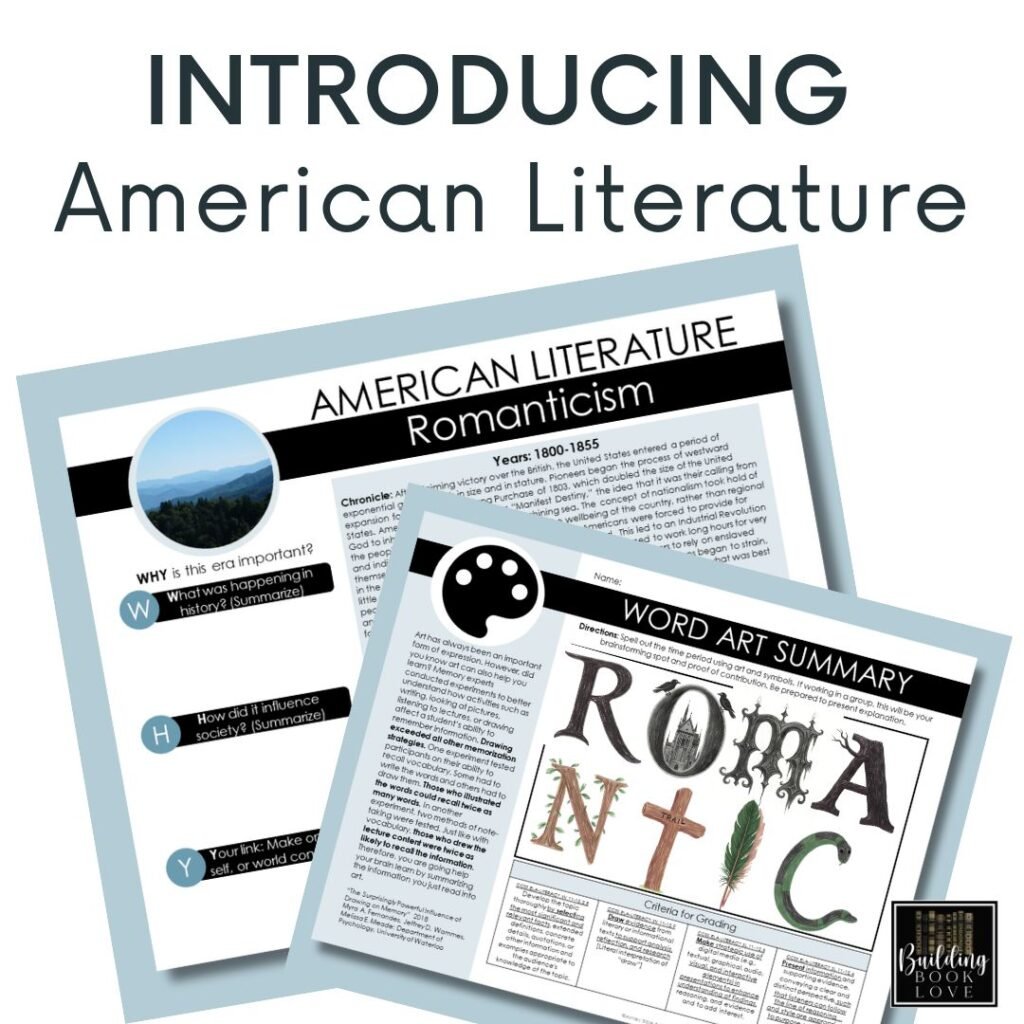
Introducing American literature movements just got a whole lot easier. Instead of hearing students groan when you assign lengthy backgrounds out of an American literature textbook, you’ll see their eyes light up when you bring out the supplies for Word Art Summaries. The idea is to provide ~just enough~ information to give them the literary movement context and have students summarize that era into word art.
The benefits of Word Art Summaries are plenty. Not only is drawing scientifically proven to help us remember things, but you can display the summaries around the room to refer back to them throughout the unit. Plus, you never have to think about how to introduce a time period ever again! This strategy can be used with every American literature movement, and you can get everything you need for this activity here: American Literature Time Period Introductions

American Literature Movements
American literature movements include:
- Early American literature (Creation Stories- 1800)
- American Romanticism (1800-1860)
- American Realism (1860-1914)
- American Modernism (1914-1939)
- American Contemporary Literature (1939- Present Day)
Early American Literature

Colonial Speeches and Texts
Early American textbook selections are more bland than a Puritan pantry. But you know what they say about variety, right? It’s the spice of life and can be the spice of your Early American unit, too.
Rather than drudge through those dusty colonial texts alone, pair them with some perspectives that will add just enough interest and a hint of controversy to keep students engaged. There are two sides to every story. What can we learn from both?
If you want to learn exactly how to make these pairings happen, keep reading here:
- There is no Early American Literature without Native American Literature
- 5 Activity Ideas for Teaching Sinners in the Hands of an Angry God
- Early American Literature Unit Plan

The Crucible
I know, I know. The Crucible is technically a modern text. However, many English teachers (including myself) place it here because the setting fits nicely with Early American lit, plus it’s a fun play that helps to break up two back-to-back challenging units.
Read more about how to make the magic happen here:

American Literature Romantic Period
If Puritan literature is all rules and restraint, American Romanticism is its rebellious, dramatic teenager phase. The Romantic movement is all about more: more feelings, more nature, more permanence. There are a lot of great American literature must reads in this era, but the difficult part is helping students understand how moody authors like Poe fit in with earthy authors like Thoreau. A little trick is to nickname the movements within the movement.
- Dark Romanticism– The moody, shadow-filled corner of Romanticism that students love. Think Edgar Allan Poe’s “The Raven,” “The Oval Portrait,” or “The Pit and the Pendulum” and Washington Irving’s “Sleepy Hollow” or “The Devil and Tom Walker.” These selections are perfect for leaning into mystery, obsession, and a touch of the supernatural.
- Green Romanticism– This is the nature-obsessed branch of American Romantism that believes people are at their best when they’re independent, self-reliant, and out in the woods. Think Transcendentalism texts like Ralph Waldo Emerson’s “Nature” and Henry David Thoreau’s Walden. These are the original “touch grass” authors.
- Grey Romanticism– Lastly, you have “grey” Romanticism, which encompasses two iconic American poets—Emily Dickinson and Walt Whitman—who critics often place somewhere between Romanticism and Realism. Their works bend rules, blur genres, and give you the perfect bridge into the next literary movement.
If you’re ready to explore every shade of American Romanticism, check out:
American Literature Realism
After the romantic ramblings, Realism comes in to kill all our hopes and dreams. Realist authors want to show the world as it was, not as they wished it to be. That means everyday characters, real struggles, and settings so vivid that students can almost feel the heat, smell the smoke, or hear the gunfire. A few must read selections for this movement include:
- The Narrative of the Life of Frederick Douglass – A firsthand account that shows “how a man was made a slave [and] how a slave was made a man”
- The Gettysburg Address – Short, sharp, and real, Lincoln’s speech distills the essence of the Civil War into just 272 words.
- An Occurrence at Owl Creek Bridge – A short story that blurs the line between reality and perception in such a way that students will never see the twist coming.
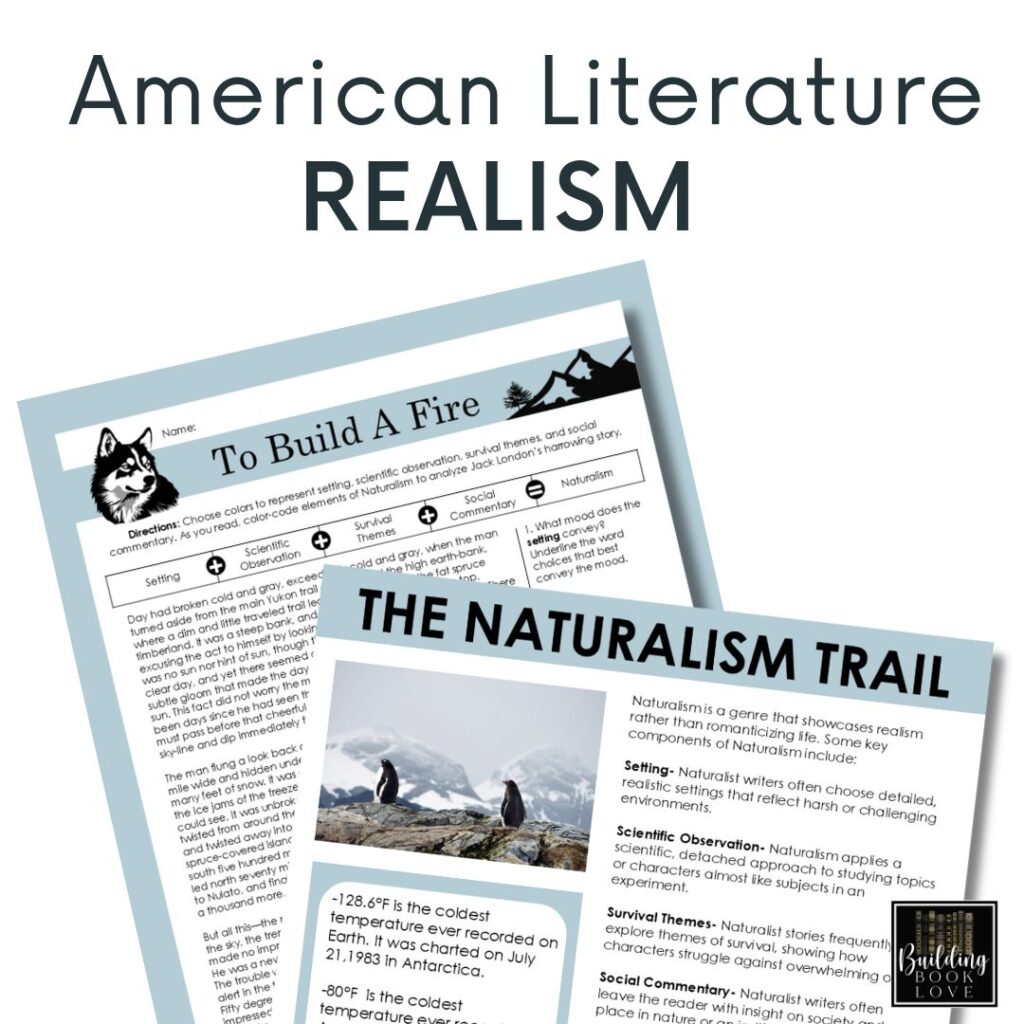
- To Build a Fire – Naturalism at its finest, Jack London’s bone-chilling short story reminds us that nature doesn’t care about our ambitions.
Realism is perfect for getting students to think about the reality of American history instead of the romanticized ideals.
If you want to dig deeper into this literary movement, check out:
- Naturalism Short Story: Teaching To Build a Fire by Jack London
- Teaching “The Battle with Mr. Covey” by Frederick Douglass
- American Literature Bundle

American Literature Modernism
If Romanticism is about dreams and Realism is about reality, then Modernism is about asking if American dreams can ever become a reality. Born out of the disillusionment after World War I, Modernist authors experimented with structure, voice, and style, breaking literary “rules” left and right. The result? Works that feel fresh and relevant even a century later.
The Great Gatsby
Two major highlights of this era include The Great Gatsby and The Harlem Renaissance. You can treat both as separate units, or you can do what I do and combine them! Knowing that I always ran out of time by the end of my American Literature course, I decided to create a unit that pairs Harlem Renaissance poetry with The Great Gatsby passages. The result adds depth and perspective to the Jazz Age masterpieces.
If you want to dive deeper into Modernism, check out:
- Meaningful & Fun Activities for Teaching The Great Gatsby
- The Great Gatsby and Harlem Renaissance Unit Plan
American Literature: Harlem Renaissance
After your Gatsby unit, you can get more into the Harlem Renaissance with interesting extension ideas and creative projects. The Harlem Renaissance is a cultural explosion full of poetry, music, art, plays, and dance. Exploring this period of American Literature gives students an opportunity to celebrate the ART in English Language Arts.
For inspiration and ideas, keep reading here:

Contemporary American Literature
And that brings us to current times. What do contemporary American literature books say about current hopes, fears, and culture? This is the perfect time to incorporate some creative, student-centered lesson plans that prompt students to explore this question. Some ideas include:
I hope this overview has made you feel calmer and more confident about teaching your 11th grade American Literature course. If you would like a free and editable American Literature outline, you can grab that here.
If you’d like the relief of knowing you’ve got detailed pacing guides and 5-star resources to help you along the way, then be sure to check out this highly discounted American Literature bundle!
American Literature Homeschool Curriculum
If you’re a homeschooling parent, I hope this blog post was also helpful to you. This American Literature Curriculum is editable to fit your needs and student interests. There are plenty of creative assignments and hands-on projects to fit your unschool schedule while also ensuring your learners are exposed to the classic American Literature canon. This American Literature Curriculum is all about making great literature accessible, meaningful, and fun, no matter where learning happens.

