Teaching the Harlem Renaissance can help you put the Arts back into English Language Arts. From poetry to paintings, this era of American literature is vibrant and bursting with creativity across multiple disciplines. Do you want your students to be jazzed about this cultural movement? Here are some fun Harlem Renaissance lesson plans to bring this unit to life!
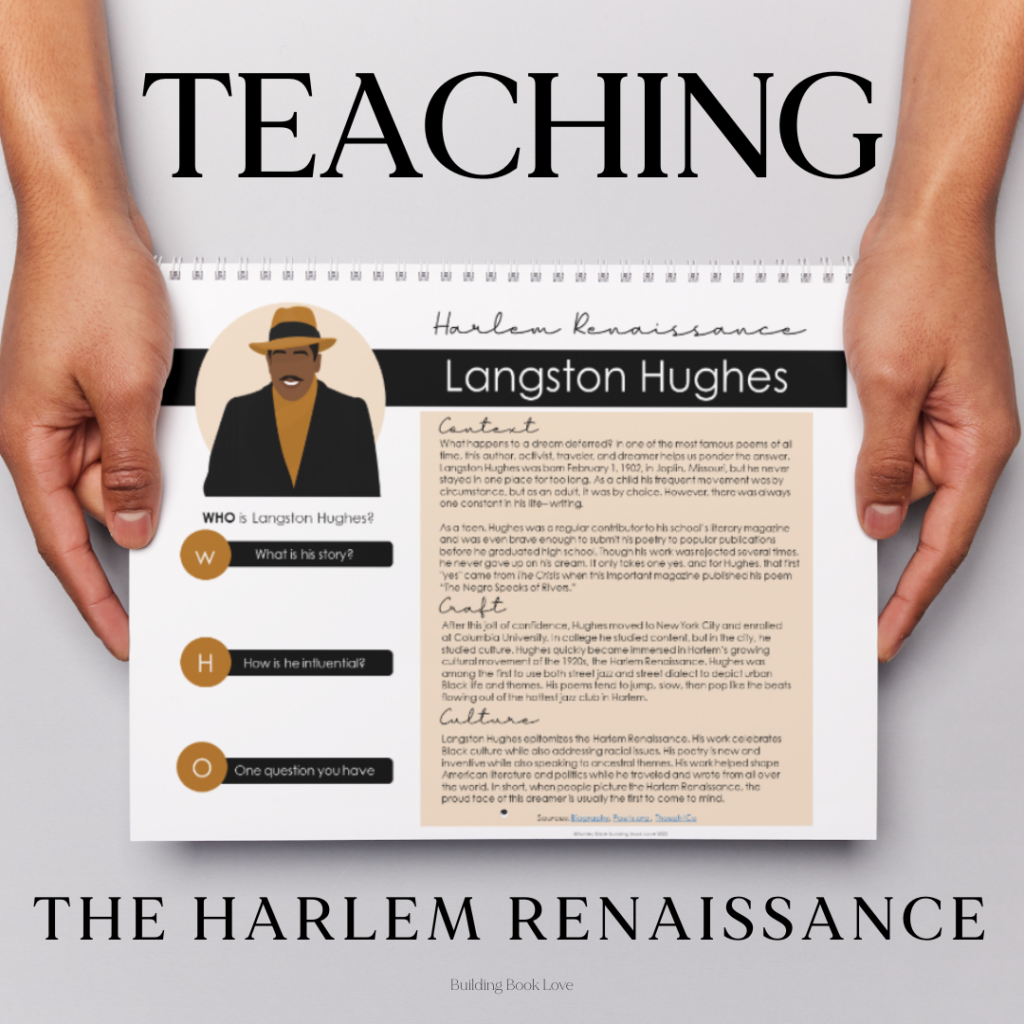
Harlem Renaissance Unit Timeframe:
If you teach American literature in chronological order, then you know just how easy it is to run out of time to do the Harlem Renaissance justice. I can relate, and that’s why I designed this Harlem Renaissance Unit Plan to be flexible and doable no matter your time constraints.
Here are some sample timelines:
- 0 Days: If you have little to no time to teach the Harlem Renaissance, but have Gatsby in your curriculum, then I recommend pairing The Great Gatsby with The Harlem Renaissance. This Gatsby Unit Plan provides prose and poetry pairings to help you do just that. Or, you can use the Harlem Renaissance poems in this resource to pair with any reading selections throughout your ELA curriculum or to use in your poetry unit.
- 1-2 Days: If you have one to two days to devote to exploring the Harlem Renaissance, then divvy up the biographies and poetry in this Harlem Renaissance Unit and have students learn about a Harlem Renaissance artist, do the Harlem Renaissance activity, then present their insight to the group. This way, students will at least get a quick overview of this rich literary period.
- 1 Week: One week is a great amount of time to do a fun introduction, sample poets, and fit in one Harlem Renaissance project!
- 2 Weeks: Two weeks is enough time to do this entire Harlem Renaissance Unit Plan. Students will get a well-rounded overview of this cultural era through Harlem Renaissance projects and poetry.
Harlem Renaissance Introduction
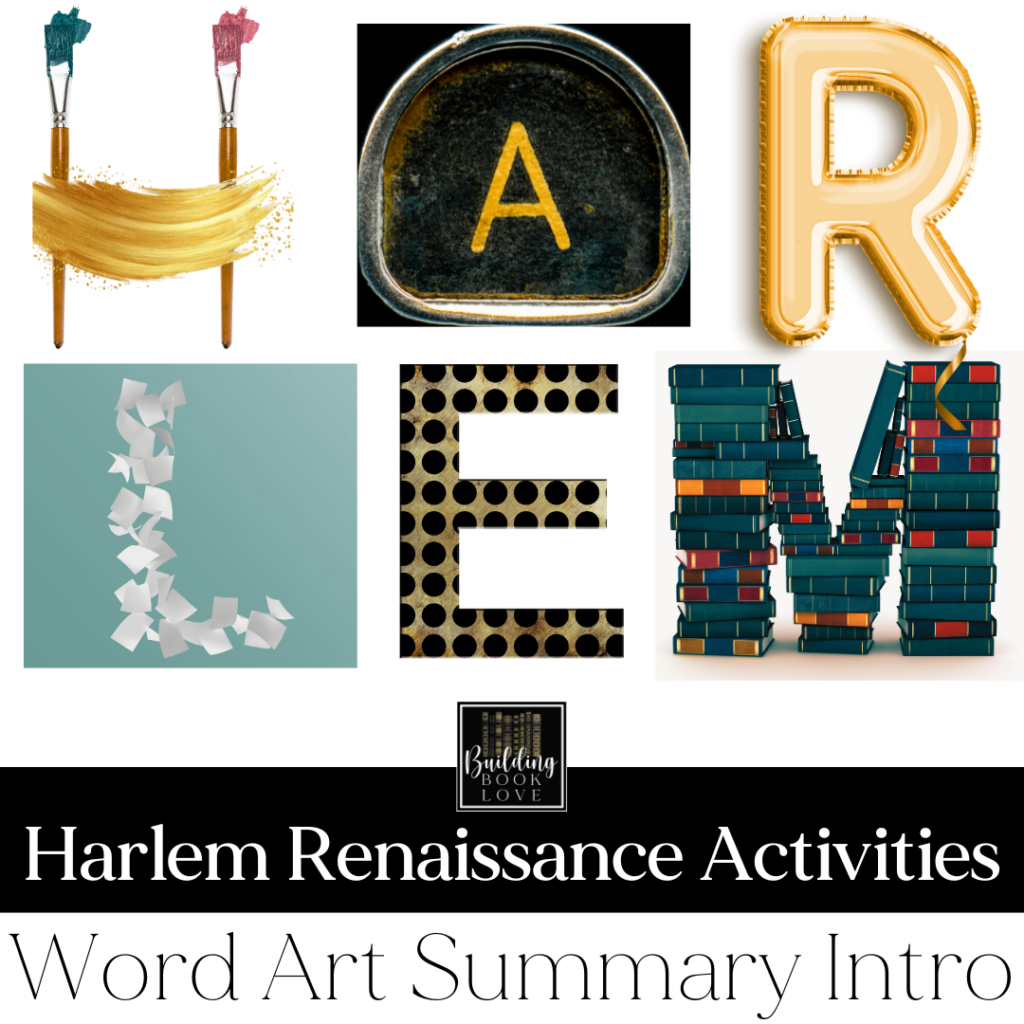
The Harlem Renaissance is all about art, so kick off your unit on a creative note with Word Art Summaries. Perfect for introducing a unit, this Harlem Renaissance activity helps students synthesize introductory material into visual art that literally spells out what they’re learning. So in this case, students will spell out the word HARLEM using creative elements that represent the cultural, political, and social contexts for the works and artists they will be exploring.
This activity offers flexibility too: students can watch or read the content, depending on what works best for them and your classroom. After exploring the material, they design their Word Art and defend their creative choices using evidence from the sources. It’s a fun way for students to practice backing up their ideas while building a foundation of knowledge about one of America’s most influential cultural movements.

Harlem Renaissance Theme
The major themes of the Harlem Renaissance are the celebration of Black culture and the power of artistic expression. A fun way to introduce these themes and other topics is with a Harlem Renaissance BINGO board. As you can see, students can use the board to see how well they relate to topics, try to guess how they might all be connected, and get a visual general overview of this vibrant cultural movement. Would you like a copy of this Harlem Renaissance BINGO board? You can grab FREE resources by signing up for my Building Book Love Letter here:
HARLEM RENAISSANCE LESSON PLAN IDEAS
Harlem Renaissance Poetry
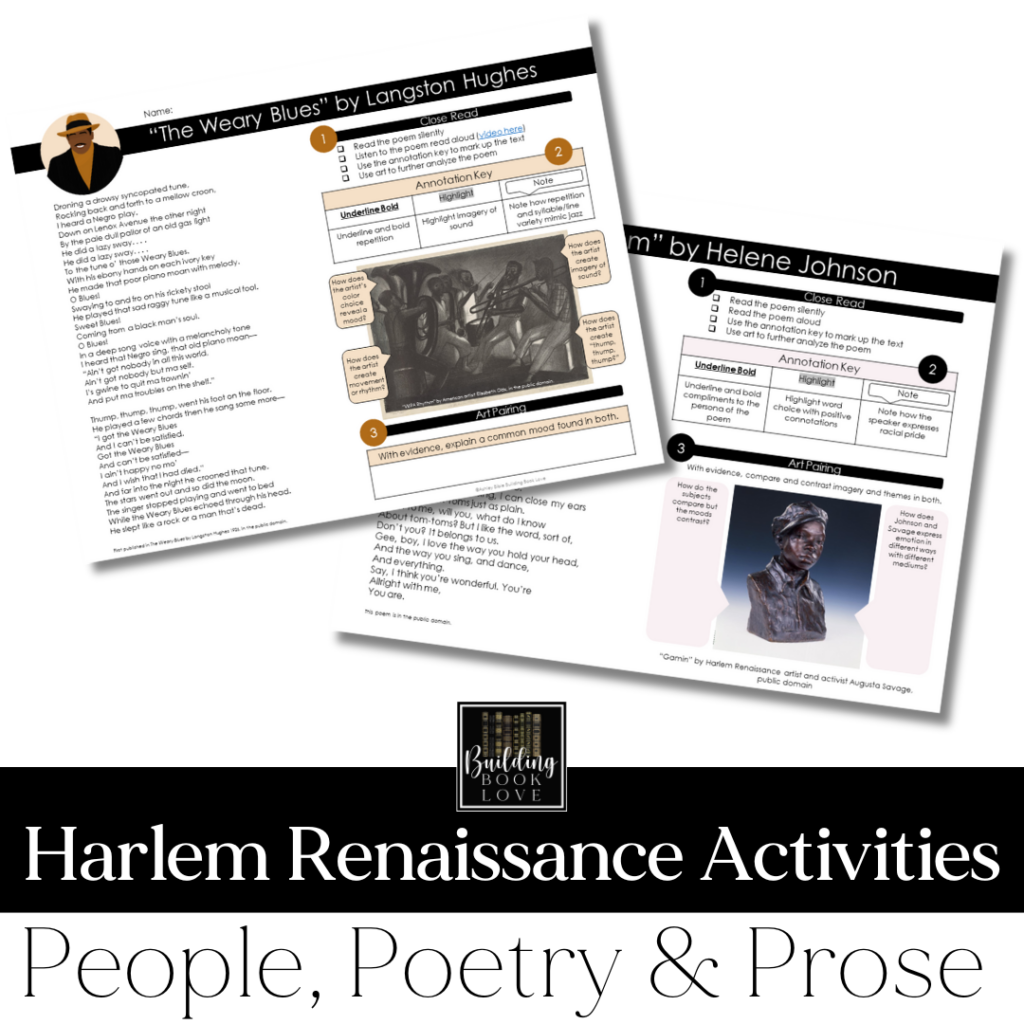
As a student, I thought the entire Harlem Renaissance was Langston Hughes. That’s because he’s an English teacher favorite (and for good reason!), but only reading one Harlem Renaissance poet will do the movement a disservice. To get a better overview, students need to see a wide variety of Harlem Renaissance art. That’s why I designed the poetry selections in these Harlem Renaissance lesson plans to showcase lesser-known Harlem Renaissance poets as well as visual artists.
This Harlem Renaissance Unit allows students to make specific connections and demonstrate their analysis skills in quick but thought-provoking ways. The activities range from collage creation to art interpretation and are creative and diverse enough that students won’t feel like they are repeating the same task over and over. The texts within the activity are also varied and expose students to many styles and voices while still focusing on the works and contributions of some of the Harlem Renaissance’s greats. This Harlem Renaissance Unit Plan contains 20 poetry selections from:
♦ Langston Hughes
♦ Georgia Douglas Johnson
♦ Claude McKay
♦ Zora Neale Hurston
♦ Countee Cullen
♦ Helene Johnson
♦ Jean Toomer
♦ Gwendolyn Bennett
♦ Alain Locke
♦ Effie Lee Newsome
Together, these help English teachers show that there was way more than one exceptional Black author during the 1920s.
Harlem Renaissance Projects
Harlem Renaissance projects provide a great way for students to explore the aspects of the Harlem Renaissance that they are most interested in learning more about. This Harlem Renaissance Unit provides a variety of project choices, and guest English teacher Erica Walker will now share her favorites.
Over my years of teaching the Harlem Renaissance in both AP and mainstream ELA, I’ve realized that I am genuinely fascinated by this rich and wondrous time in American history. As a result, the Harlem Renaissance has made its way from simply historical context in a novel study to its rightful place as an entire unit of focus within my courses. And while the period is rich, vibrant, and bursting with creativity in its very essence, I’m always looking for new ways to help my students explore this content. This unit plan is full of creative and engaging activities for teaching the Harlem Renaissance and exposing students to a variety of artists and their contributions to this Black cultural mecca in early 1900s America.

HARLEM RENAISSANCE HOW IT STARTED… HOW IT’S GOING
The name of this activity got me really excited, and it didn’t disappoint! In this task, students take a side-by-side look at how the influences of Black artists in the past are seen in our modern era. This Harlem Renaissance activity is a great opportunity for examining and celebrating Black joy – a recurrent theme in both the unit and approach to teaching and learning about the Black experience in America. This task directly looks at the experiences of artists and creative types during the Harlem Renaissance and gets students to make connections in a formula that (likely) feels familiar to them. While completing this activity, students will be able to recognize how their lives, social media trends, and modern art are all connected to the pursuits and triumphs of the greats of the Harlem Renaissance.

gEOGRAPHY OF GENIUS HARLEM RENAISSANCE ACTIVITY
Based on the theory explored by Eric Weiner in his book, The Geography of Genius, this activity provides students with an opportunity to understand and appreciate the role of community in creating a movement. A well-rounded study of the Harlem Renaissance should focus on the talents and contributions of a variety of artists, and this task sets up students to recognize that these masters of their crafts were not operating in isolation and that it was a direct result of their community that they were able to pursue their gifts and leave an everlasting imprint on cultural development in America and beyond.
Students are asked to take what they’ve learned from their reading on various Black artists of the time and explore the connection between what Weiner lays out as the required elements for creating genius communities. After making connections between the Harlem Renaissance and Weiner’s ideas, students are given a chance to make personal connections to these concepts. This last portion of the activity really sees students letting their creative juices flow as they do some research on genius communities that they may thrive in for their post-secondary studies. Like most of us, I’m always looking for ways to make what I’m teaching feel relevant to my students’ lives and while a study of the Harlem renaissance may seem an unlikely place but it’s…genius!

HARLEM RENAISSANCE EXTENSION ACTIVITY
While candles and teaching the Harlem Renaissance seem an unlikely pairing, it is precisely what makes this activity such a creative option and a real think-piece for students. I love getting my students to think outside the box, and this is the perfect activity to engage them in making connections between two seemingly unrelated things. This extension activity idea also touches on media strands by getting students to think about the marketability of their scent creations. Click here to browse the “mentor text” candle company that inspired this Harlem Renaissance activity. Having students share their brainstorms and justify some of their choices would make for great classroom conversation and an excellent way for me to identify how my students are retaining what they’ve learned about these figures and their works.
I hope these creative Harlem Renaissance activities inspire you to take your Harlem Renaissance unit to the next level or at least encourage you to carve out more time in your year for it because it’s definitely worth it! If you love these ideas as much as I do, check out Ashley’s Harlem Renaissance Unit Plan for all of these activities and more!

