Some of the most powerful learning happens when students have a real audience and a real purpose — and few subjects deliver that more naturally than journalism. In this collaborative post, teachers are sharing their best ideas for teaching journalism in high school. From podcasts to projects, there’s something here for every kind of journalism student!
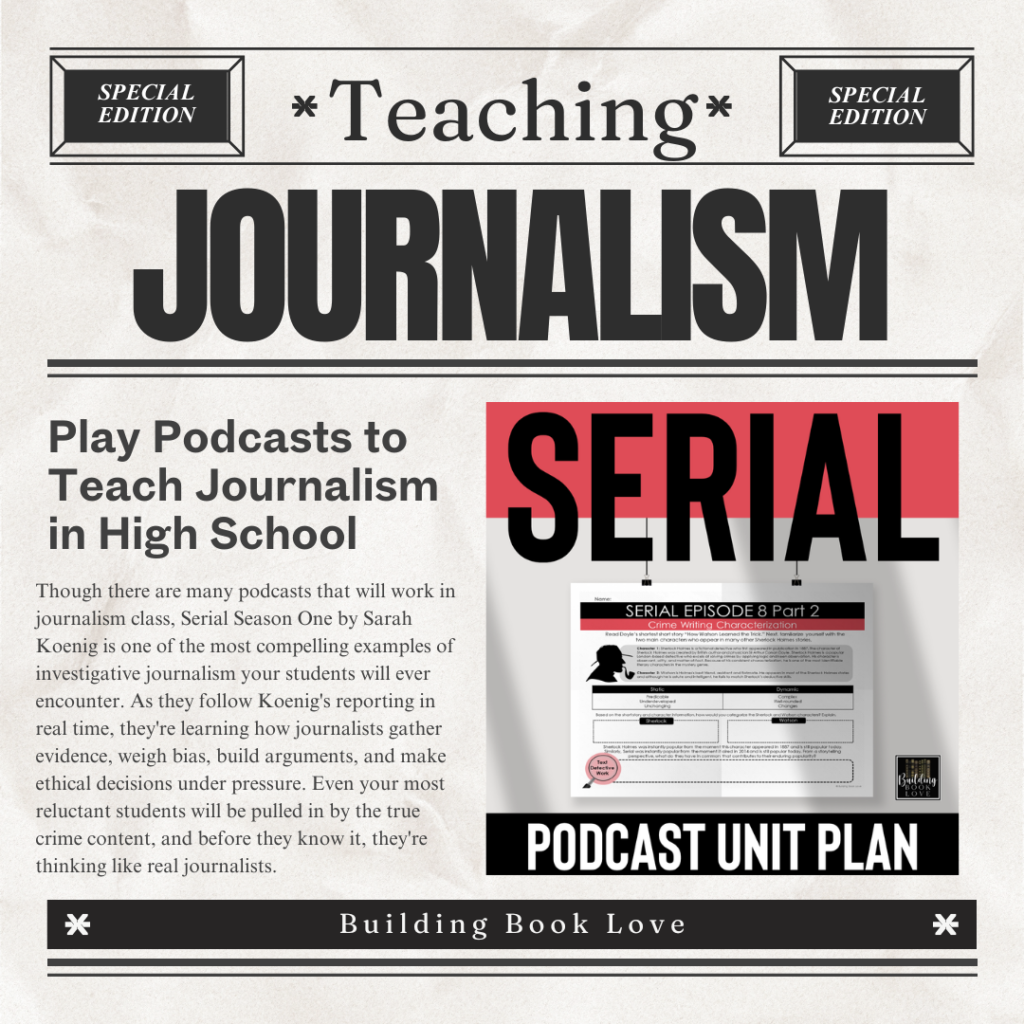
Play Podcasts to Teach Journalism in High School
What if your journalism students solved a cold case?
That’s exactly what happened in a neighboring district not far from me. Prompted by a journalism project, a group of East Tennessee high schoolers cracked a nearly 40-year-old serial murder mystery, and their investigative work is now featured on a syndicated podcast called Murder 101.
That kind of student-driven inquiry is exactly what great journalism education looks like. If you want to bring that same detective energy into your classroom, mentor journalism podcasts are the perfect place to start!
Though there are many podcasts that will work in journalism class, Serial Season One by Sarah Koenig is one of the most compelling examples of investigative journalism your students will ever encounter. As they follow Koenig’s reporting in real time, they’re learning how journalists gather evidence, weigh bias, build arguments, and make ethical decisions under pressure. Even your most reluctant students will be pulled in by the true crime content, and before they know it, they’re thinking like real journalists.
Ready to get started? Download these Serial Journalism Lesson Plans and watch your students turn into real-world investigators! –Ashley Bible, Building Book Love
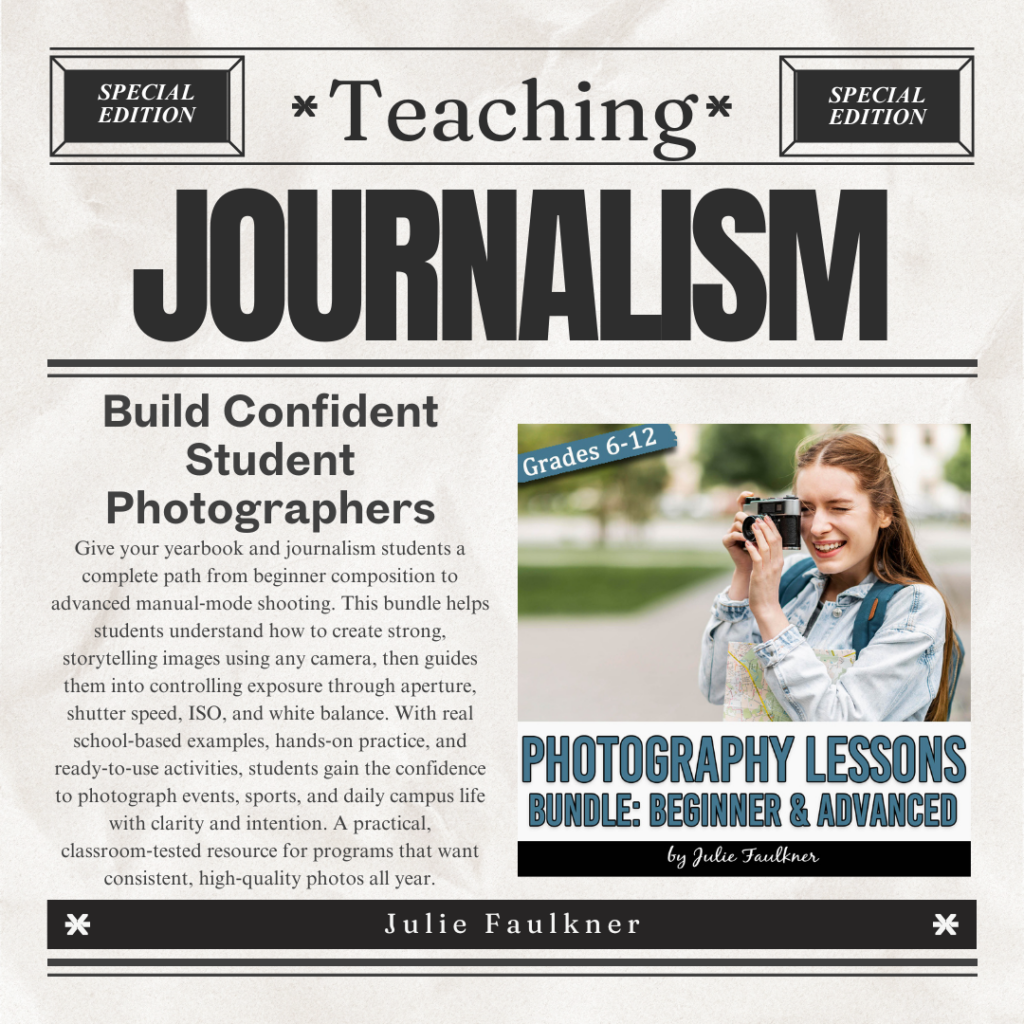
Build Confident Student Photographers
Photography is the heartbeat of any publication, and it’s often the part that students get excited about the most. However, student journalists usually don’t start out knowing how to capture the best photos with any camera or even how to effectively tell the best story through photographs. The key is teaching staffers the basics and then giving them authentic opportunities to practice, while building a gallery of great images for your publication.
Before they head out, beginners work through my Basic Photography Lesson, where they learn composition, lighting, and how to shoot with intention. More experienced photographers jump into the Advanced Photography Lesson, sharpening their eye for emotion, depth, and narrative. Then everyone grabs a camera and steps into the hallways with one mission: capture the truth of the school.
One of my favorite projects to give students authentic practice early in the year is my Photography Project: Documentary of Student Life, inspired by the street‑photography film Everybody Street. Students document real life as it happens — no staged smiles, just authentic, candid storytelling. What makes this project so meaningful is how real it is. Students begin observing, anticipating, and thinking like photojournalists. One teacher who used this project said, “My yearbook kids loved this! We used it at the beginning of the year to get them used to the cameras and taking pictures.” Once students catch the photography bug, it’s easy to keep the momentum going with seasonal photography mini‑projects that build skill and fill your photo library with authentic, usable images.
And if you’re new to teaching photography or if your staffers are just starting, my new post, How to Teach Photojournalism When Your Students Are Total Beginners (But Your Publication Still Needs Great Photos), explains everything you need to know about building confident student photographers.– Julie Faulkner, Julie’s Classroom Stories, Faulkner’s Fast Five Blog
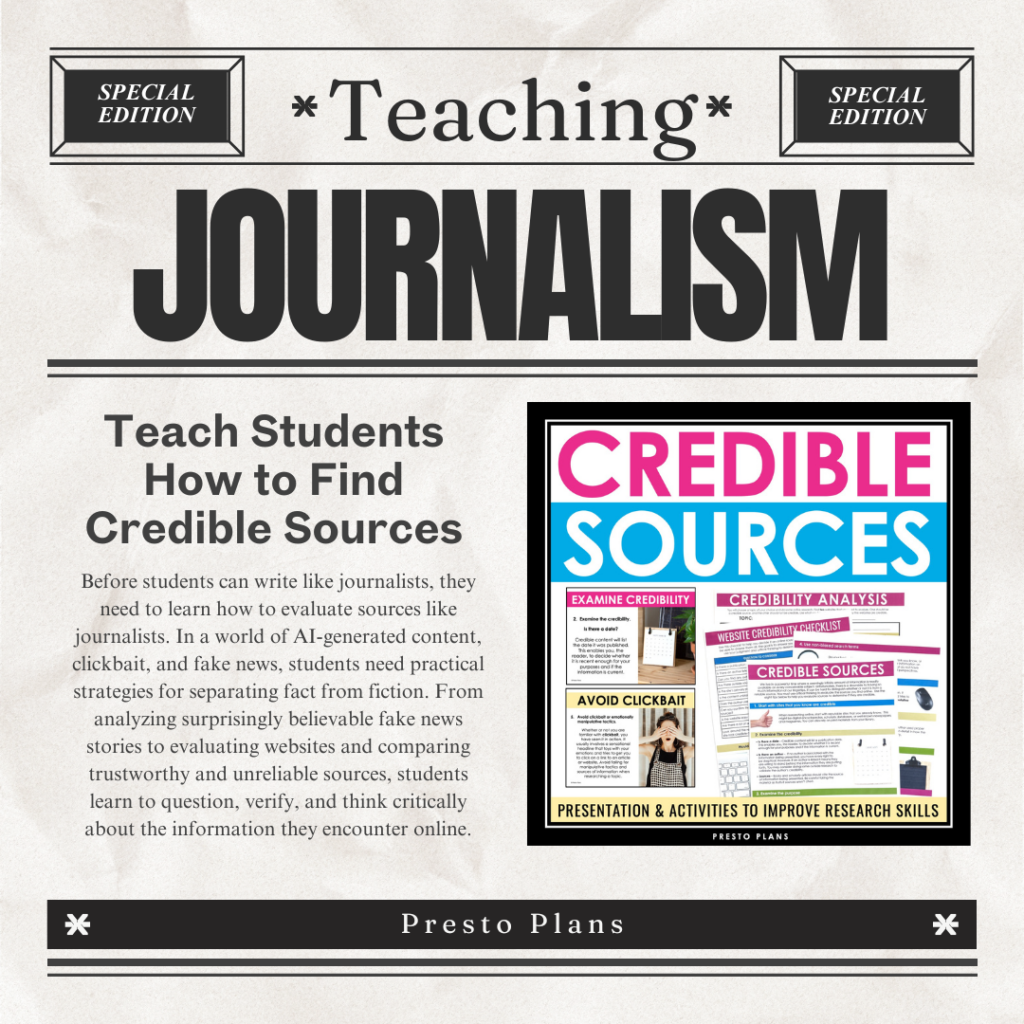
Teach Students How to Find Credible Sources
When teaching journalism, it can be tempting to jump right into having students write articles. The problem is that many students haven’t yet developed the skills they need to determine whether the information they’re finding is actually true. In a world of clickbait headlines, AI-generated content, fake news, and social media algorithms that feed us exactly what we want to hear, teaching students how to separate fact from fiction is more important, and more challenging, than ever. That’s why I think one of the most valuable journalism lesson plans you can teach has nothing to do with writing at all; it has to do with evaluating sources.
One of my favorite ways to introduce the topic of credible sources is with a BBC video that claims spaghetti is harvested from trees. While the idea sounds ridiculous, the report looks and sounds like a legitimate news story. It has professional production, confident narration, and all the credibility cues that make us instinctively trust a source. It’s a fun way to show students that appearance alone isn’t enough to determine whether information is trustworthy.
Once students understand what to look for, have them put their skills into practice. Try having students use a credibility checklist to evaluate websites by examining things like publication dates, authorship, website purpose, domain names, bias, clickbait tactics, writing quality, and website design. Then, they can compare two websites on the same topic, one credible and one unreliable, and build a case for which source they would trust and why. Students quickly realize that professional-looking websites aren’t always trustworthy.
Want to try these activities in your journalism class? Check out my Credible Sources Media Literacy Lesson. – Bonnie, Presto Plans
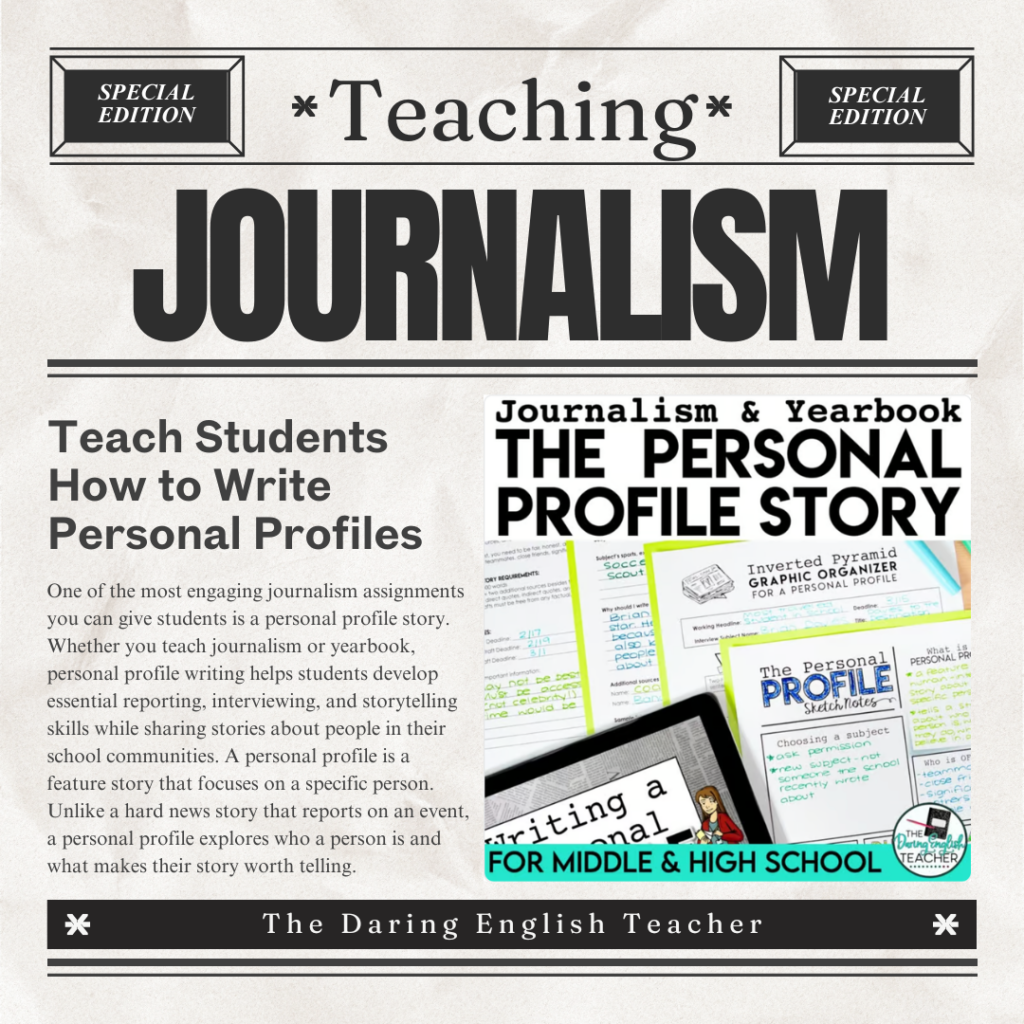
Teach Students How to Write Personal Profiles
One of the most engaging journalism assignments you can give students is a personal profile story. Whether you teach journalism or yearbook, personal profile writing helps students develop essential reporting, interviewing, and storytelling skills while sharing stories about people in their school communities. That is why I always include this personal profile assignment in every journalism class.
A personal profile is a feature story that focuses on a specific person. Unlike a hard news story that reports on an event, a personal profile explores who a person is, what motivates them, what challenges they have faced, and what makes their story worth telling. These human-interest stories help readers connect with the people who shape a school and community.
Personal profile writing teaches some of the most important skills in journalism. Students learn how to conduct meaningful interviews by asking open-ended questions, listening actively, and following up to gather deeper information. They also develop feature writing skills as they learn to craft compelling leads, organize information strategically, and incorporate direct and indirect quotations. Most importantly, students practice journalistic ethics by focusing on accuracy, fairness, fact-checking, and avoiding conflicts of interest.
One reason I love teaching personal profiles is their versatility. Every school is filled with interesting people and untold stories. I use this assignment twice each year: at the beginning of the year, when new staff members interview one another and write their first stories, and again at the end of the first semester as a culminating journalism project. My personal profile writing unit is also included in my year-long journalism curriculum. – Christina, The Daring English Teacher
Teaching Journalism in High School Conclusion
The ideas in this post are just the beginning. Teaching journalism looks different in every classroom, and that’s exactly what makes it so exciting. Pick one strategy that fits your students, your publication, and your community. Then let them run with it. You might be surprised by what they uncover!

