
Macbeth is (bloody) hands-down my favorite Shakespeare play to teach. I love all things witchy plus my Ancestry DNA results reveal I’m 25% Scottish, so this drama tracks. Once high schoolers get over the challenging language, Macbeth can be a lot of fun for students too because it lends itself well to creative activities. Teaching Macbeth allows students to dig into universal themes such as ambition, power, and morality while helping them tap into their creativity through interactive notes, reenactments, and group activities.
With a solid Macbeth unit plan, you’ll be able to break the boredom curse and help students appreciate Shakespeare’s tragic tale.
So with that…
Double, double no toil or trouble
Macbeth engagement is going to double!
What happens in macbeth?
First, let’s start with a quick Macbeth overview.
This Scottish tragedy follows the ambitious general Macbeth who encounters three mysterious witches that predict his rise to power. Macbeth’s ambition is further encouraged by his ruthless wife, Lady Macbeth. This play quickly spirals into a nightmare of guilt, paranoia, and bloodshed. The drama unfolds through supernatural encounters, psychological torment, and political chaos. High school students love the witches, the gore, and the fast-paced action that guides the play!
Macbeth Themes
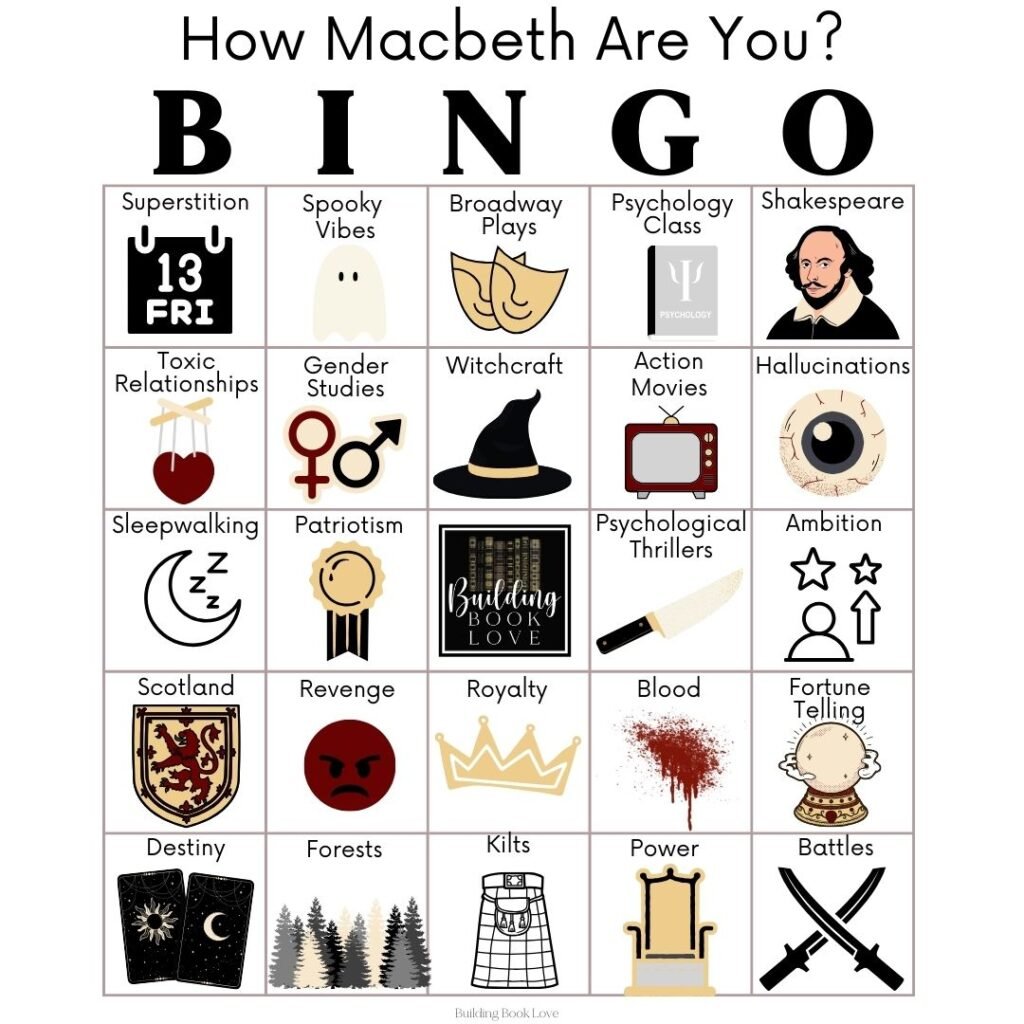
The main themes of Macbeth are ambition, power, and destiny. A fun way to introduce these themes and other topics is with a Macbeth BINGO board. Students can use the board to see how well they relate to topics, try to guess how they might all be connected, and get a visual general overview of the play. Would you like a copy of this Macbeth BINGO board? You can grab this FREE Macbeth activity by signing up for my Building Book Love Letter here:
Macbeth Pre-Reading Activities
Like with every unit, it’s important to hook students from the start! Here are some Macbeth intro activities that will spark their curiosity and help set the tone of the play:
Intro to Macbeth Hook with Ambient Media:
When you are thinking about an introduction to Macbeth, go rummaging through your Halloween decorations. As you see in this reel, hanging a few witch hats and projecting some creepy ambient media does wonders in setting the stage to engage.

Introducing Macbeth with Stations:
Before diving into Macbeth, it’s essential to cast a spell of curiosity. That’s where the Macbeth Introduction Stations come into play. Here’s the premise: each group rotates through these stations, spending a 6-7 minutes at each station. The goal is to spark students’ interest and get them excited about the Macbeth unit.
Here are a few station ideas for introducing Macbeth:
Station 3: To truly appreciate Macbeth, students need to understand the context. At Station 3, they watch a video that provides insights into the world Shakespeare inhabited. After watching, they summarize the context by answering questions like who Shakespeare had in mind when he wrote Macbeth and why witchcraft made its way into the play. This Macbeth activity adds curiosity and context.
Station 4: Literature is a mirror to our world and ourselves. Station 4 involves reading an informational text that explores the superstitions surrounding Macbeth. Your students will have to infer and predict what themes they’ll be exploring during this study. It’s an engaging Macbeth activity that encourages critical thinking and reflection.
Station 5: Students then take a closer look at the essential question: Is our future determined by destiny or choices? At Station 5, students will engage in a lively discussion about how different individuals, from musicians to fortune tellers, would answer this question. This essential question will guide all the Macbeth activities.
With these Macbeth Introduction Stations, you’re setting the stage for introducing Macbeth in a way that provides an overview, sparks curiosity, and adds movement all in one!

Teaching Macbeth Playbill:
One of the challenges with teaching Macbeth is keeping all the names straight, both with the characters as well as student readers. One easy way to solve this issue is to create a Macbeth playbill that makes students feel like they are going to watch a legit production and also serves as a Macbeth character list reference sheet.
Macbeth Unit Plan Ideas
These Macbeth lesson plans have two resources that are the unifying stars that guide the entire unit: Interactive Notes and Acting Troupe Drama Activities. They’re incorporated through the entire Macbeth unit plan, ensuring that your students not only understand Shakespeare’s language but also bring it to life. The interactive notes help students decipher the text, the Macbeth discussion questions promote critical thinking, and the drama activities add an element of fun. Together, they create an engaging learning experience for all!

Keep Track of What Happens in Macbeth
One of the keys to making your Macbeth unit plan more accessible and engaging is by providing students with interactive notes. Shakespeare’s language can be a bit of a puzzle, but with the right tools, it becomes easier to understand. Throughout this unit, students will be armed with these interactive notes, designed to help them decipher the text. It also helps to show scenes being acted out so that students can better understand the meaning. I bookmarked a fantastic site that organizes Shakespeare’s plays by acts and scenes. It shows a clip and then has the words embedded underneath each video.
The beauty of using interactive notes and showing select scenes is that it helps focus on the most important parts of the play so that students can closely read and comprehend without being overwhelmed.

Teaching Macbeth Group Activities
Now it’s time for the real fun to begin: the Acting Troupe Drama Activities! Shakespeare’s plays were meant to be performed, not just read, and this is where your students get to truly step into the shoes of the characters.
With these Macbeth drama activities, your class will form acting troupes that will collaborate and take on various scenes and acting challenges from Macbeth. Here’s a glimpse at the Macbeth group activities throughout the play:
- Brainstorm a creative acting troupe name
- Play a sound ball theater game in Act I
- Perform a mini-drama in Act II
- Design a finger puppet set in Act III
- Do a character walk theater game in Act IV
- Create a theme tableau in Act V
These Macbeth activities give your students a chance to tap into their creativity and kindle their competitive side. And the best part is students are having FUN while also deepening their comprehension of the play.
Macbeth Discussion Questions:
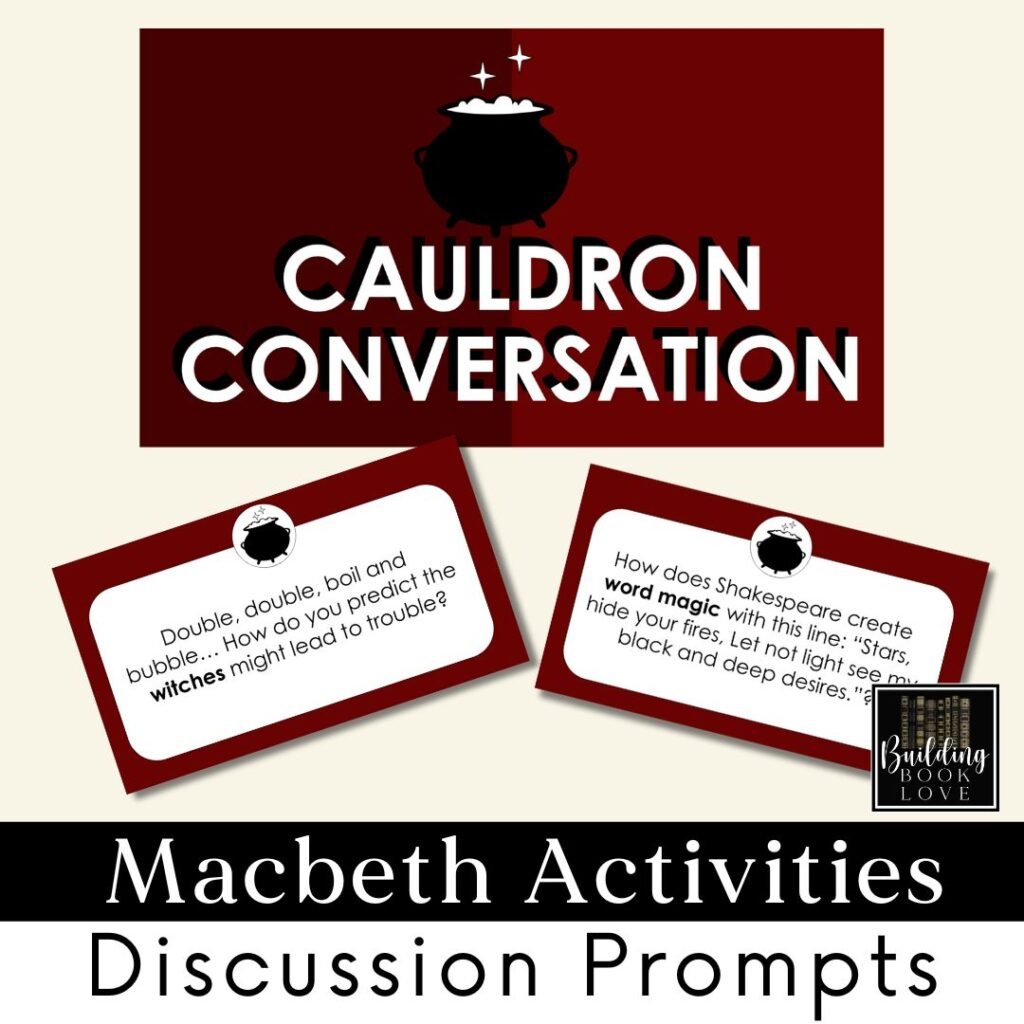
A fun way to get students talking about Macbeth is to host “Cauldron Conversations.” Taking a cue from the witches, these Macbeth discussion prompts are magic themed and more engaging than your traditional questions. Some examples include:
- How does Shakespeare create word magic with this line: “Stars, hide your fires, Let not light see my black and deep desires.”?
- Double, double, boil and bubble… How do you predict the witches might lead to trouble?
- If you were told by a magical source that you would achieve great power—would you do anything to make it happen or wait to see if it came true on its own?
These three Macbeth activities anchor the play, but there’s lots you can sprinkle in to keep students engaged with Shakespeare. Here are some Macbeth activity ideas for each act.
Macbeth Act I (Act 1) Activities
In the most eerie and iconic openings of all Shakespeare’s plays, Macbeth’s stage directions tell us to cue the thunder and lightning as the three witches enter the scene. But have you ever wondered how special effects were created in the 1600s without the technology we have today? Stagehands had to get creative and so will your students! Here are some Macbeth lesson plans ideas to bring act I to life:
- Use interactive notes to break up the text and chunk close reading
- Help students explore drama techniques through warm-up games
- Have students to look up their horoscopes and discuss if any of it rings true or if it’s nonsense.
- Host a Socratic Seminar for Macbeth using the “Cauldron Conversation” questions

Macbeth Act II (Act 2) Activities
As we enter Act II, the plot thickens, the characters’ ambitions deepen, and the supernatural forces continue to cast their spell. Here are some Macbeth unit plan ideas to help students comprehend the events as they unfold:
- Use interactive notes to keep track of the plot and practice close reading skills
- Incorporate drama techniques by having groups act out an important scene
- Explore the real-world concept of self-fulfilling prophecies
- Use a film adaptation or theater performance to show the play as it was meant to be

Macbeth Act III (Act 3) Activities
Act 3 of Macbeth takes us further into the heart of darkness, where ambition spirals out of control and conscience haunts the minds of the players. Here are some Macbeth activities to keep students engaged with Shakespeare’s play:
- Use interactive notes to summarize important information and analyze key scenes
- Incorporate set design by having students create a finger puppet play for an important scene
- Explore ghosts in literature
If time remains after these Macbeth Act 3 fun activities, students may have the chance to explore the spooky role of ghosts in literature. Ghosts have long been a prominent element in storytelling, and this topic always generates lots of student engagement! Here are some essential questions for Macbeth:
- 👻What makes a good ghost story? (literary elements)
- 👻Why are ghosts so prominent in literature and folk stories? (ideas from articles)
- 👻Why did Shakespeare include Banquo’s ghost? (brainstorm)

Macbeth Act IV (Act 4) Activities
Act 4 is a cauldron of consequences, where the supernatural and human worlds collide. Here are some Macbeth lesson plan ideas to keep students curious and connected to the text:
- Play the “Double Trouble” clip from Harry Potter and the Prisoner of Azkaban as an allusion to Macbeth.
- Use interactive notes to track character motivation and development
- Incorporate drama techniques by having groups play a drama game

Macbeth Act V (Act 5) Activities
In the final act of Macbeth, the stage is set for a conclusion filled with moral reckoning. To ensure teaching Macbeth leaves a lasting impact on your students, this Macbeth Unit Plan provides thought-provoking activities that will deepen their understanding of the play’s themes and characters. Here are some ideas for ending the play:
- Conduct a handwashing experiment for a hands-on way to better comprehend the “Out dammed spot” scene
- Use interactive notes to process the ending and analyze the themes
- Incorporate drama techniques by creating Theme Tableaus

Teaching Macbeth Post Reading Activities
Once you’ve finished the play, it’s time to prompt students to think critically about the themes in Macbeth.
For a real-world connection, students can also explore Mesmin Destin’s TED Talk about the positive influence of words in shaping a person’s future. It’s a thought-provoking exercise that encourages students to draw parallels between the themes in Macbeth and the real world. With this Macbeth worksheet, they’ll examine how words shaped Macbeth’s tragic fate and compare it to the ideas presented in the TED Talk. This activity bridges the gap between literature and life, showing how language can be a force for good or ill in an individual’s journey.
Macbeth Project Ideas
I have already mentioned several Macbeth project ideas to use throughout the play, such as the Drama Troupe group projects and Handwashing experiment.
Additionally, you could also easily extend the TED Talk mentioned above into a Macbeth Project. For example, a Macbeth project idea is to have students create a ‘life coaching’ plan for themselves. They will research possibilities, funding, successful people like them, and more, and then write about how their future goals are possible.

Macbeth Movie Guide
Plays are meant to be watched! One of the best ways to review Macbeth and ensure comprehension is to watch a production of the play. Here are some choices for a Macbeth movie adaptation by William Shakespeare.
Macbeth Movie Adaptations:
Please note that just like the play itself, all Macbeth movie adaptations contain violence and dark themes. Preview each option carefully before showing it to your class.
The Tragedy of Macbeth (2021) R – The most recent major film adaptation, directed by Joel Coen and starring Denzel Washington and Frances McDormand. Shot in stunning black and white, this critically acclaimed version is a visually striking choice for the classroom (with parent permission given its R rating).
Macbeth (2015) R – Starring Michael Fassbender and Marion Cotillard, this visually stunning adaptation is widely considered one of the most faithful and atmospheric versions of the play. Due to its R rating, it’s best suited for high school classrooms with parent permission.
Macbeth (1971) R – Though it’s vintage, this is one I always showed in my high school classroom. Roman Polanski’s classic adaptation is raw and true to the play, bringing the play’s darkness to life in a way that resonates with older students. This one is also rated R, so preview carefully before showing. Personally, I only needed to fast forward through one short scene of Lady Macbeth’s backside.
Macbeth Essay Prompts
If you need Macbeth essay prompt ideas, I include 3 unique prompts in my Macbeth Unit Plan.
These Macbeth essay prompts and discussion points are invitations to explore the timeless Macbeth themes while encouraging students to think critically about the world around them.
Throughout this Macbeth unit, students are exposed to multiple themes that are still relevant today, which makes this a favorite read for many students. Hopefully, this post and this Macbeth unit plan have given you lots of meaningful and fun activities for teaching Macbeth!
Do you teach other Shakespeare plays? Keep reading here:


[…] You can read more about how to teach Macbeth in this post: Meaningful and Fun Activities for Teaching Macbeth […]