
Sometimes fighting back feels like opening the pages of a book. Bridging the political divide sounds like civil classroom discussions. And practicing your civic duty looks like teaching Animal Farm by George Orwell. These Animal Farm lesson plans are designed to help you get to the heart of Animal Farm while making your efforts mean something. With your guidance, students will dig deep into Animal Farm history, themes, and allegory in order to better apply Orwell’s message to their own lives right here, right now.
Animal Farm Short Summary
But before we get into the Animal Farm lesson plans, here’s a quick refresher:
On the surface, Animal Farm is a simple story about a group of farm animals who rebel against their human farmer. They want to live free, equal, and happy. However, on a deeper level, Animal Farm is an allegorical warning about power, corruption, and the dangers of totalitarianism.
What grade level is Animal Farm?
Animal Farm is one of those rare books that work in a variety of grade levels. You know those college courses that teach Harry Potter? It’s kind of like that. As mentioned, on the surface, this is a simple story that can be taught in middle school. However, the allegory can go as deep as you want to take it, which is why it’s also a popular high school pick.
Animal Farm George Orwell Themes
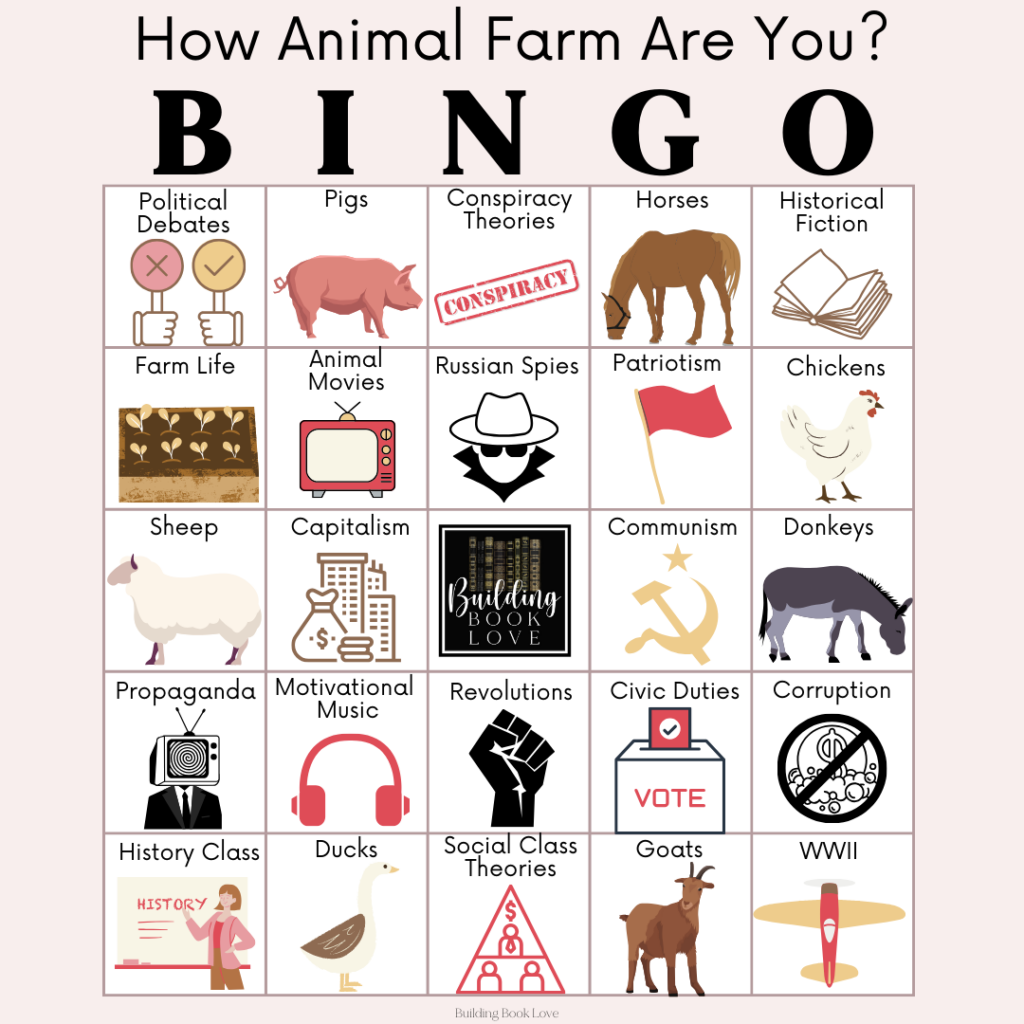
Before I begin planning for any unit, I ask myself what the number one theme I want my students to understand is. As you can see in the Animal Farm George Orwell free BINGO, there are so many facets this novel can take. But, if they only remember one thing ten years from now, what would I want it to be? It’s not keeping up with the character names and who they represent in the Russian Revolution, and it’s not keeping the Animal Farm’s important events in order. No, I want teaching Animal Farm to provide a much bigger takeaway. I want students to be able to think critically about political messaging and take action on their civic responsibilities.
If you’d like a copy of this free Animal Farm lesson plan, you can grab it here.

Animal Farm Pre-Reading Activities
Like with every unit, it’s important to hook students from the start with engaging pre-reading activities! Here are some Animal Farm introduction ideas that will spark their curiosity and help set the tone:
Animal Farm Intro Stations
One of my favorite ways to hook students is through introduction stations. This approach gets students up and moving while building the background knowledge they’ll need to understand Orwells’ world.
Set the mood by playing Animal Farm ambience as they walk in the door. Then, group students and have them rotate through each station, filling out their record sheet as they go.
These stations cover:
- Predicting with Animal Farm cover art
- Previewing with Bookish BINGO
- Connecting with animal symbolism
- Summarizing Russian Revolution context
- Inferencing with an allegory example
- Questioning with anticipation questions

Animal Farm Posters
Another thing I use for introducing Animal Farm is to display the commandments during our Animal Farm Unit. I put the Animal Farm posters up and change them every time a commandment is altered on the farm. I never draw attention to them or mention them once they are up. Undoubtedly, students forget about the propaganda posters for Animal Farm and don’t notice when they change…until the last one. Since the final Animal Farm poster is drastically different, it’s so much easier to notice. This leads to a powerful discussion in which students recognize how important it is to follow the news and take a stand against corruption.
Animal Farm George Orwell Chapter 1
Chapter one kicks off the allegory with Old Major’s speech which represents The Communist Manifesto by Karl Marx. It goes without saying that this text has a taboo history in America so why not play that up? If something was once so off limits that you could be canceled just for reading it, then it must be super juicy, right? Well, not exactly, but they don’t have to know that. They’ll eagerly close read a high-level text just to see what the fuss is about.
Once they grasp the foundation of the allegory, then teachers can make it relevant to today. How does capitalism differ from communism? How does communism differ from socialism? How does socialism differ from capitalism and where might there be some common ground? Here are some teaching Animal Farm ideas for comprehension and comparison:
- Use emojis to define capitalism, communism, and socialism
- Discover some socialist and capitalist-leaning public figures. Any surprises?
- Find common ground on issues like poverty and health care.
Animal Farm Lesson Plans Chapter 2
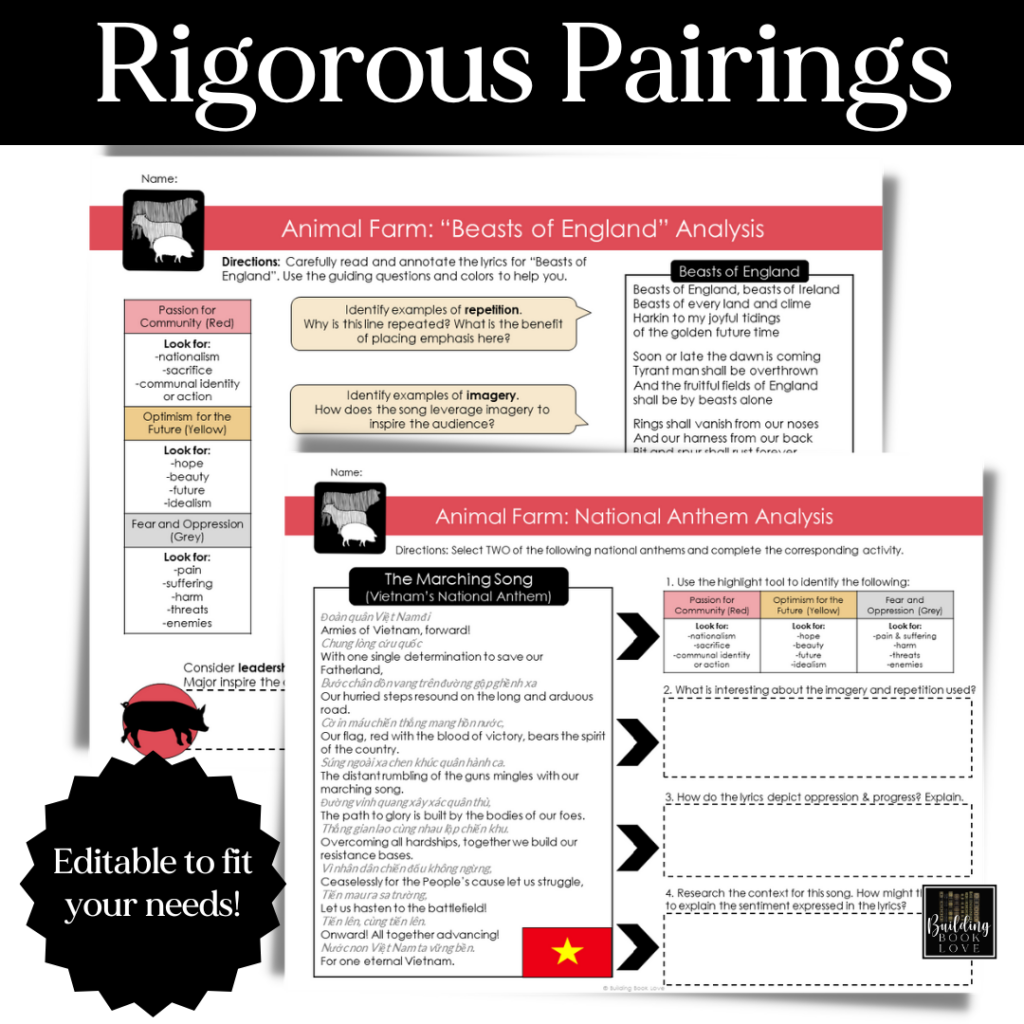
Chapter two is the honeymoon phase of the animal rebellion. One of the Animal Farm project ideas for this unit is to have students create a utopian one-pager. Just like the animals, students will create a vision of their perfect society. They’ll design the laws, flag, and anthem. Here are some more Animal Farm lesson plans for chapter two:
- Analyze anthems from around the world
- Compare the animals’ utopia with your own

Animal Farm Teaching Ideas Chapter 3
Chapter three shows the farm in full productivity mode. Everyone is working according to their abilities, and for a brief moment, the utopia seems achievable. That is, until the milk and apples go to the pigs. Here are some teaching Animal Farm propaganda examples:
- Do a farm jobs simulation to spark discussion about the theory of communism
- Teach real-world rhetoric using milk commercials
- Anyaze Animal Farm propaganda using Squealer’s milk and apples speech
To promote critical thinking in the real world, students learn to recognize propaganda and analyze how it’s used for political agendas. First, students analyze how Squealer is able to persuade the animals not to speak up against the missing milk. They look for ethos (emerald green), pathos (pink), and logos (light blue), then break apart his speech into specific propaganda techniques.
To keep with the same topic for a clear comparison, I then show three milk commercials, all of which predominantly use ethos, pathos, or logos. Next, we look at specific propaganda techniques and discuss how this level of analysis should go into every political persuasion attempt we encounter.
Animal Farm Lesson Activities Chapter 4
Chapter four brings the first real conflict as neighboring farms try to retake Animal Farm. But on an allegorical level, this chapter gives some insight into how other countries reacted to the Russian Revolution (aka Red Scare). Here are some teaching Animal Farm ideas for understanding the allegory:
- Play a short video that teaches about the Red Scare
- Match elements in the book with their allegorical counterparts
- Learn the intriguing history of how the US has promoted Animal Farm (including a CIA funded cartoon version) and make predictions about the rest of the novel.

Animal Farm Unit Plans Chapter 5
Chapter five is where things take a turn towards totalitarianism. Napoleon unleashes his personal police (the dogs) and the pigs start making all the decisions on the farm. Here are some Animal Farm lesson plans for chapter five:
- Simulate herd mentality with a class experiment
- Read an article about herd mentality and how to prevent it
- Create political cartoons that represent themes in Animal Farm
An interesting thing about our current political climate is that both sides think the other side are “sheep.” Perhaps this has some truth to it. Though we might fancy ourselves to be independent thinkers, social media tends to create echo chambers and non-biased sources are difficult to access.
To analyze this further, host a gallery walk that showcases sheep political cartoons from every angle. Just google “Political Cartoons with Sheep” and a bunch of examples will come up:

Lastly, using StoryBoardThat or their own artistic gifts, students can create their own Animal Farm political cartoon to satirize and show understanding of herd mentality.
Animal Farm Chapter 6 Activities
Chapter six shows the animals working harder than ever on the windmill (well, except for the pigs) yet their rations are being reduced (again, except for the pigs who have now moved in the comfort of the farmhouse). Here are some Animal Farm lesson plan ideas for comprehension and critical thinking:
- Teach logical fallacies
- Analyze the logical fallacies in Animal Farm
- Discuss power and corruption

Animal Farm Lessons Chapter 7
Chapter seven fully reveals just how far the animals have slipped away from their vision of utopia. In fact, Napoleon bans their anthem “Beasts of England” to distance themselves from the original goal of the revolution. Napoleon also spreads fake news of how well the farm is doing which couldn’t be further from the truth. Here are some Animal Farm activities for applying the lessons of the allegory to real-life:
- Build an Animal Farm propaganda bar graph
- Learn to spot fake news and misinformation
- Question who is to blame for the harm of fake news
- Explore censorship and its effects on a free society
An interesting way to keep up with Squealer’s propaganda while teaching Animal Farm is by having students create a literary bar graph. Not only does this prompt students to take notice of propaganda in Animal Farm, but it also creates a great visual to discuss. What do you notice? How does Orwell believe most citizens are manipulated?
Animal Farm Activities Chapter 8
Chapter eight brings the destruction of the windmill—all that work, all those sacrifices, destroyed in an instant. Here are some teaching Animal Farm ideas for tapping into the symbolism of the windmill:
- Pair a poem for deeper analysis
- Explain the symbolism of the windmill
- Create paper windmills to showcase student understanding

Farm Lesson Plans Chapter 9
As an animal lover, chapter nine gets me every time. The social divide between the pigs and other animals highlights exploitation and inequality, and the allegory makes it easy to see the injustice and corruption of it all. Here are some Animal Farm activities for applying the lessons of the allegory to real life:
- Examine economic division
- Calculate retirement probability
- Discuss causes of economic inequality
Animal Farm Teaching Ideas Chapter 10
Chapter 10 brings us full circle and ends with one of the most iconic lines in literature, “The creatures outside looked from pig to man, and from man to pig, and from pig to man again: but already it was impossible to say which was which.” Here are some Animal Farm lesson plans for ending the novel:
- Host a socratic seminar for Animal Farm
- Explore political growth mindset
- Outline an Animal Farm essay
While I’ve always found the themes in Animal Farm important, I have a hard time leaving my students with the cryptic ending. It wasn’t until recently that I realized I could change this. Benjamin the donkey provides the ultimate example of a fixed political mindset. He doesn’t believe he can make a difference and just sits back and watches as his country falls into despair. This is the exact opposite of the mindset I want to instill in my students. Therefore, I want my students to recognize the pitfalls of a fixed political mindset and work to change theirs to a growth political mindset. This can be done with a fun role-playing activity.

First, students don these ridiculous Benjamin the Donkey hats and act out how he would respond to motivational quotes such as, “Be the change you wish to see in the world.” Next, students look at passages from the text and reword Benjamin’s fixed mindset into a growth mindset. Lastly, students put on the “wise owl” hat and respond to negative quotes such as, “If voting helped anything, they would make it illegal.”

Projects for Animal Farm
I have already mentioned several project ideas for Animal Farm to use throughout the novel, such as designing a utopia one-pager, building a bar graph with Animal Farm propaganda examples, drawing political cartoons, and creating a windmill. If you are looking for even more Animal Farm project ideas, here you go:
There’s no point in reading Animal Farm if students can’t connect the text and theme to issues in their lives. To help them find connections, I like to find modern-day pairings that use animals to spread political messages in the way Orwell does. A really good example of this is Zootopia!
If you haven’t seen Zootopia or if you’ve only watched it as a children’s cartoon, then you might be surprised to realize there are lots of important messages in this film. Most important is their use of animals to illustrate inequality in a world perceived as equal. This plays very well into Orwell’s message of “All animals are equal, but some animals are more equal than others.”
If you are teaching Animal Farm, you can grab this Animal Farm by George Orwell FREE movie guide pairing by signing up for my newsletter!
After watching, have students create their own animal allegory to simplify a message to the world.
Conclusion
I view teaching Animal Farm as my civic duty. With fake news running rampant, social media perpetuating a herd mentality, and political apathy growing by the day, I believe this book is more important now than it has ever been.
The beauty of teaching Animal Farm is that it’s not about left versus right, conservative versus liberal. It’s about recognizing the patterns of manipulation, corruption, and control that can appear anywhere across the political spectrum. It’s about teaching students to think critically, question authority when necessary, and take responsibility for their role in democracy.
If you would like the resources mentioned here as well as my complete Animal Farm lesson plans, you can check out this Animal Farm Unit Plan.
Let’s make teaching Animal Farm meaningful again—one student, one classroom, one critical thinker at a time.

