I don’t remember the first time I read A Christmas Carol by Charles Dickens because it somehow feels like I’ve always known Scrooge. However, I vividly remember the first time I tried to teach it. I’m dating myself, but we’d just received a classroom set of Nooks and one of the pre-loaded books was A Christmas Carol. I jumped at the chance to coast through December with a fun and “easy” book, ha! Needless to say, I soon realized I had underestimated this familiar novella. It’s one of those rare stories that’s universally loved, but more complex than the cartoon versions of our childhood led us to believe. So, if you are looking for A Christmas Carol teaching ideas, here’s the novel study I wish I had back then—one that better captures both the joy and depth of Dickens… and helps you coast through December. 😉
Versions of A Christmas Carol
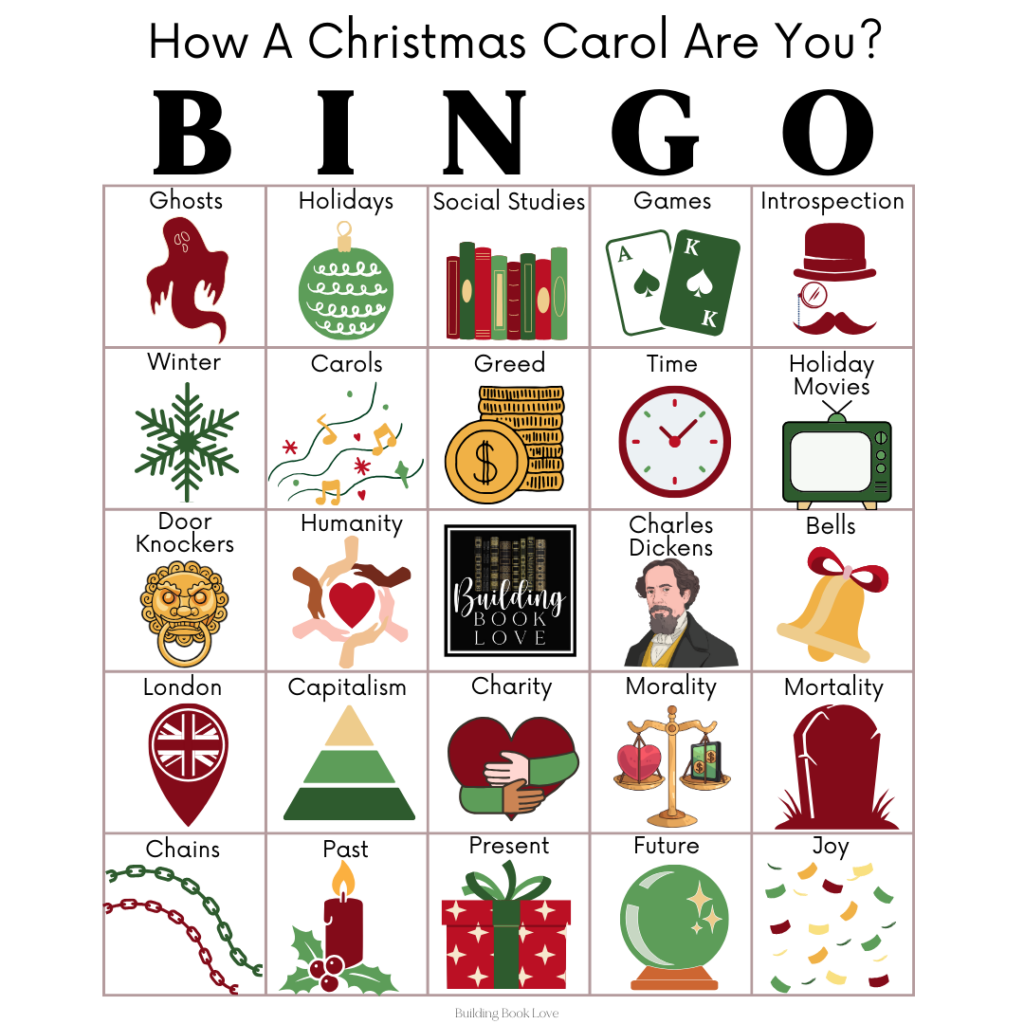
But before we get into these A Christmas Carol activities, let’s discuss which version you’ll be using. I’m a fan of the original full text, but there are plenty of other versions to suit your classroom needs. Each version is special in its own way and covers the topics and themes you see in this FREE Christmas Carol lesson. Students can use the board to see how well they relate to topics, try to guess how they might all be connected, and get a visual general overview of the story.
A Christmas Carol Play
A Christmas Carol is written in five staves or chapters, so it is easily adapted into a typical five-act play. Practically every small theatre across the globe has A Christmas Carol play performance in December, so it’s a holiday tradition that you can easily bring into your classroom!
Though I based this unit plan on the original text, it can be adapted to the play version. Here’s an email I received: Thank you, I teach an abbreviated skit version of a Christmas Carol during December, and many of the activities in the unit are perfect for pulling meaning/ discussion as we vocally ‘perform’ the play.
A Christmas Carol Illustrated Graphic Novel
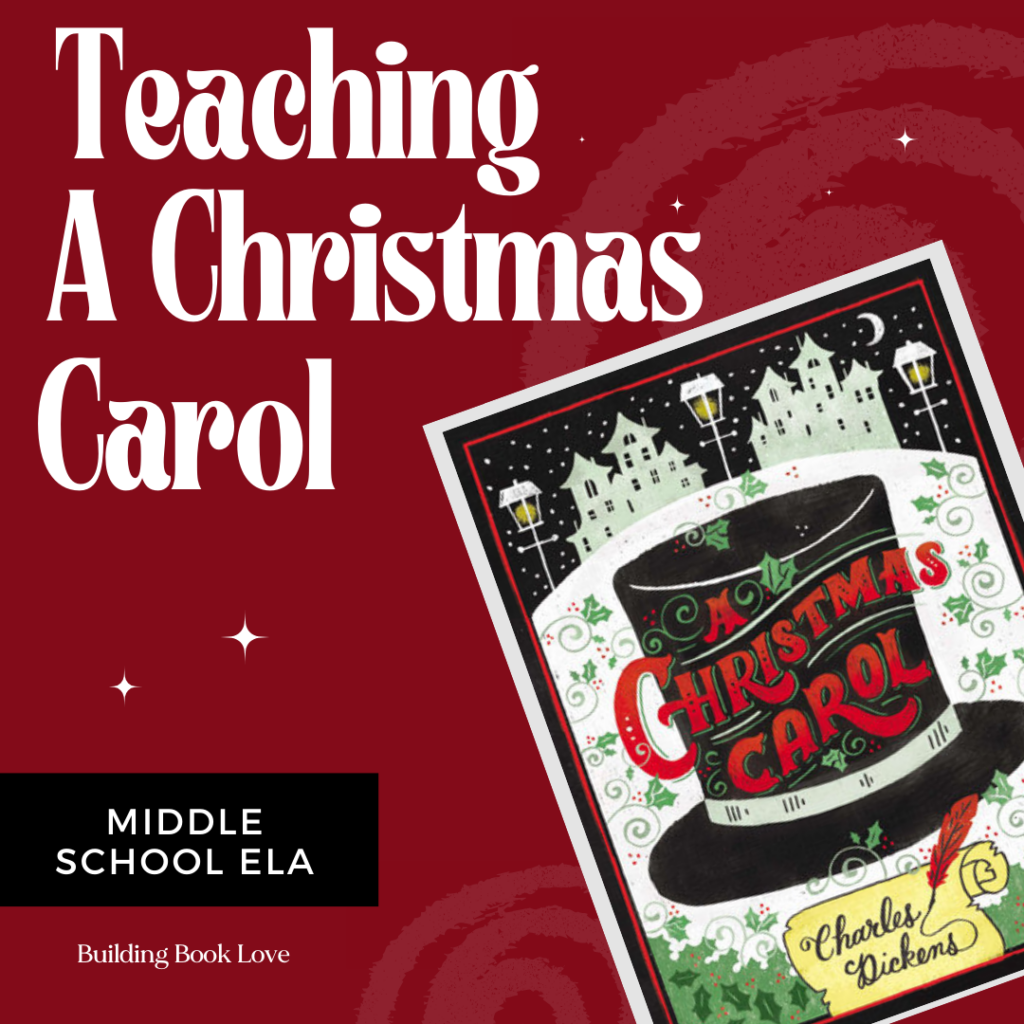
The original A Christmas Carol by Charles Dickens is illustrated, so teaching with a graphic novel version simply takes this a step further. If you want to use the full text and pair it with more illustrations, there’s also a gorgeous picture book you can use as a read-aloud. I give examples of questions you can ask about the illustrations in the teacher notes of this Christmas Carol novel study. For example, What do you notice about the color contrast of Scrooge vs the background on the cover? What might the differences symbolize?
A Christmas Carol Abridged Version
Depending on your timeframe and grade level, you may be looking for an abridged version of A Christmas Carol. There’s still a lot of meaning to be made even if you don’t teach the full text. This adaptive version from the BBC is fantastic because it chunks the staves into episodes and provides audio plus the transcripts for each. Likewise, the novel notes in this unit plan help teachers pull out the most important parts of each stave.
So no matter your format or timeline, here’s to a festive and fun Christmas Carol unit!
A Christmas Carol Pre Reading Activities
Like with every unit, it’s important to hook students from the start with engaging pre-reading activities! Here are some Christmas Carol introduction ideas that will spark their curiosity and help set a festive tone:
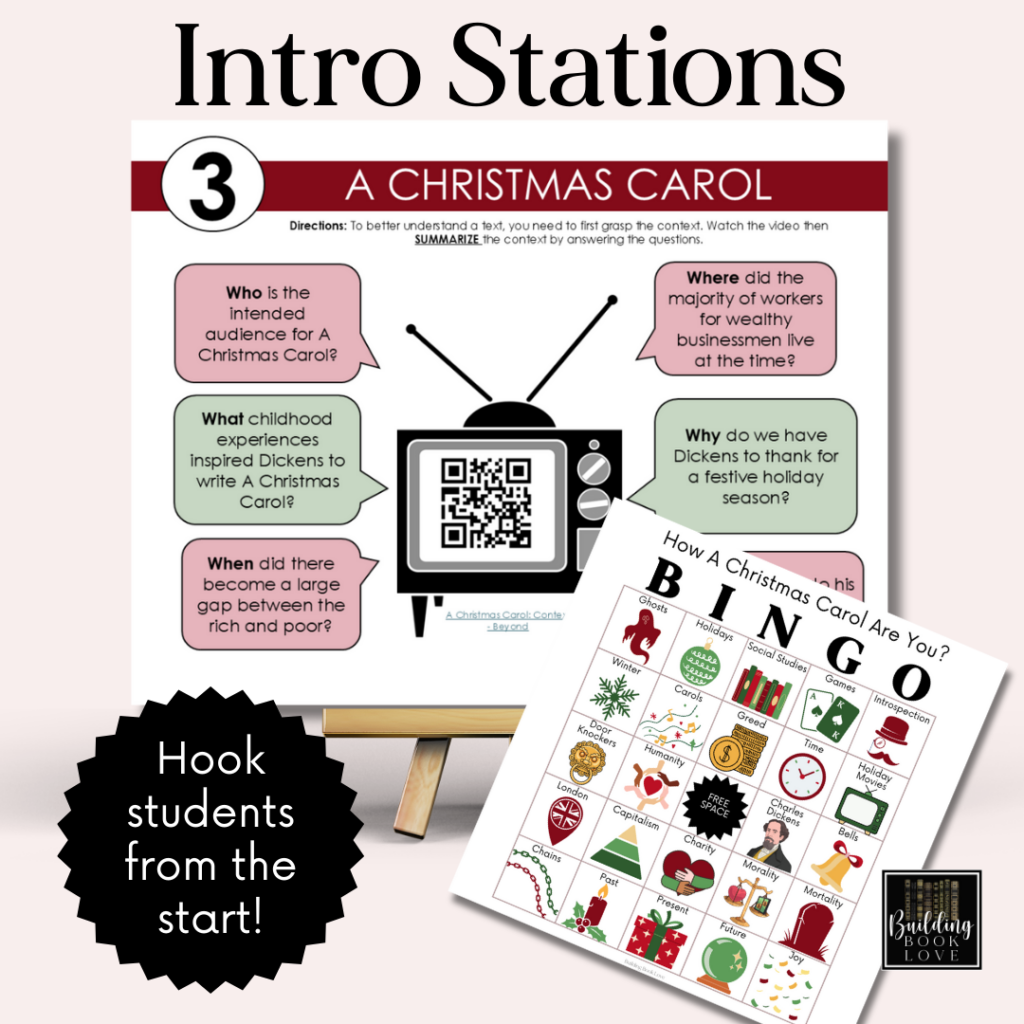
Introduction Stations
One of my favorite ways to hook students into A Christmas Carol is through introduction stations. This approach gets students up and moving while building the background knowledge they’ll need to understand Dickens’ world.
Set the mood by playing instrumental holiday music as students walk in the door. Then, group students and have them rotate through each station, filling out their record sheet as they go.
These stations cover:
- Predicting with cover art
- Previewing with Bookish BINGO
- Summarizing Dickens’s life and social reform work
- Inferencing with a real-world article on greed
- Questioning perspectives of others
- Visualizing key vocabulary
Dickens Biography
Charles Dickens was a complex character, and so much of his life’s story comes through in A Christmas Carol. I visited his home and museum in London this fall, and left with so much inspiration! Though you might not be able to pull off a London field trip, dedicate some time to Charles Dickens. There are plenty of great, short biographies available online. Grasping his childhood poverty helps students understand why he wrote with such empathy for the poor which is a crucial theme in the book.

A Christmas Carol Stave 1 Activities
Stave I opens up on a cold Christmas Eve in Victorian London. Things get even icier when we meet Ebenezer Scrooge, a miserable old man whose frosty demeanor matches the chill in the air. Thanks to the popularity of this story, most students will already have a visual of Scrooge. However, this is where the challenging vocabulary will make them realize there’s more to this classic than what they’ve seen on Disney. Here are some A Christmas Carol teaching ideas for characterization and comprehension:
- Use novel notes to annotate, paraphrase, and summarize the most important parts of Stave I
- Spark creativity by having students write characterization poems in the shape of an evergreen tree
- Work on vocabulary in context by having students match and make “weighty words” paper chains
- Get students talking with a “Teatime” discussion where the prompts sound like something you might discuss over afternoon tea with friends

A Christmas Carol Stave 2 Activities
Stave II takes Scrooge on a trip down memory lane with the Ghost of Christmas Past. These glimpses into Scrooge’s youth give us a deeper understanding of where his scarcity mindset stems from. Here are some A Christmas Carol teaching ideas for digging deeper into the themes of Stave II:
- Use novel notes to explore symbolism, word choice, and developing themes in Stave II
- Reflect on nostalgia and how it applies to Scrooge with a poetry response
- Revisit the psychology of greed article that explains how past experiences can make people greedy
- Add to the “weighty words” paper chain by continuing vocabulary in context

A Christmas Carol Stave 3 Activities
Stave III brings Scrooge into the present with The Ghost of Christmas Present and shows all the joys of life that he’s missing out on. I get something new from A Christmas Carol every time I reread it, and this time it struck me that not only does Scrooge not compensate Bob Cratchit fairly nor give to charity, but he also doesn’t spend money on himself. He hoards wealth but extracts no pleasure from it. Joyce Carol Oates recently offered a present-day comparison to ponder:

How would Scrooge respond to this message? What joys of life is he missing out on? What does it really mean to be rich in life? The Ghost of Christmas Present helps us to answer these questions. This stave is a feast for the senses, offering an answer to what it means to live in the moment and find small joys in life. Here are some A Christmas Carol teaching ideas for analyzing the themes and sensory language of Stave III:
- Use novel notes to compare and contrast Scrooge’s miserly life with the richness of others
- Practice sensory language by writing an imagery poem about a holiday tradition
- annotate, paraphrase, and summarize the most important parts of Stave I
- Work on vocabulary in context by having students match and make “weighty words” paper chains
- Get students talking with a “Teatime” discussion where the prompts sound like something you might discuss over afternoon tea with friends

A Christmas Carol Stave 4 Activities
Stave IV turns dark for Scrooge as the Ghost of Christmas Yet to Come shows him a lonely and eerie future if he doesn’t change his ways. I think if everyone could get a wake-up call like this, the world would be a better place. The way we walk through life has a ripple effect, and here are some A Christmas Carol activities for exploring the mood shift and moral lessons of Stave IV:
- Hook students with spooky graveyard ambience as they enter to signal the mood shift
- Use novel notes to explore symbolism, word choice, and developing themes in Stave IV
- Create epitaph poetry from different points of view of strangers in Scrooge’s life
- Add to the “weighty words” paper chain by continuing vocabulary in context

A Christmas Carol Stave 5 Activities
Stave V brings Scrooge into the light and ready to embrace the joys of life. It’s a fantastic opportunity to help students reflect on personal growth, second chances, and the power of generosity. Here are some engaging teaching ideas for exploring Scrooge’s transformation in Stave V:
- Hook students with merry holiday music as they enter to signal the mood shift
- Use novel notes to annotate, paraphrase, and summarize Scrooge’s transformation
- Create a patchwork poem or A Christmas Carol one-pager that shows characterization from Stave I vs Stave V
- Complete the “weighty words” paper chain that will be five staves long by now!
- Get students talking with a “Teatime” discussion where the prompts sound like something you might discuss over afternoon tea with friends

A Christmas Carol Post-Reading Activities
Victorian Parlor Review Games
Review by playing Victorian Parlor Games. These games are modeled after the parlor games Victorians actually played at Christmas parties (and mentioned in A Christmas Carol!). You can sprinkle the review games throughout the Christmas Carol novel study, or you can save them for the end for a festive and fun game day.
Holidays Around the World Connections
Since A Christmas Carol is so rooted in tradition, it’s a great jumping-off point for a Holidays Around the World research project. Have students research winter holidays and make connections to world, self, and text (A Christmas Carol).
A Christmas Carol by Charles Dickens Film
Finally, the movie! Whether you’ve played scenes along the way to scaffold understanding or saved it for the end, watching a film adaptation is a fun way to end the unit. I personally love The Man Who Invented Christmas for a meta-take on the story, but the Muppets version is a classic for a reason!
Use this movie guide to keep them accountable, but mostly, let them enjoy the story one last time.

A Christmas Carol Essay Prompts and Test
Depending on your timeframe and goals for the unit, you may want to assign an essay. I provide three research-based essay prompts in this Christmas Carol novel study. If you don’t want to take a stack of essays home to grade over winter break, consider turning this assignment into group essays.
I also provide a 30-question multiple-choice test in this complete unit plan. The questions mirror standardized test questions so you can be sure to keep students learning all the way through winter break.
A Christmas Carol Party
However, if you prefer a more festive way to end the unit, consider throwing a Victorian tea party! You can use A Christmas Carol teaching ideas like “teatime” discussion prompts, Victorian parlor games, and A Christmas Carol BINGO board for a festive and fun day before break.
If this Christmas Carol novel study marks your last few days before winter break, I hope you have a great one because you deserve it! Thank you for all you do and for teaching books that instill compassion, empathy, and generosity in the hearts of our youth.

